
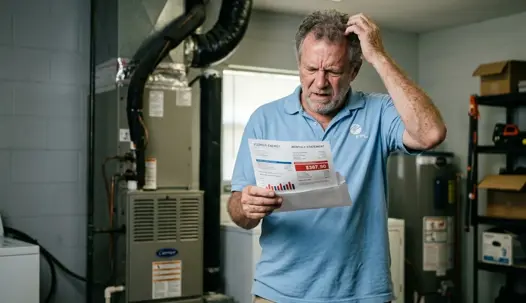
You get the power bill in mid July, and the number makes you do a double take.
Nothing in your home changed, yet the cost jumped by a hundred dollars or more.
It almost feels unfair. You're not running anything new but paying more?
Here in Orange Park, Florida, that summer energy cost spike hits almost every household. The Florida heat is relentless. Your AC unit runs for hours just to keep the house livable.
Most Florida homeowners assume it's only the weather. The truth is usually closer to home. Your air conditioner is doing the heavy lifting, and how well it runs decides what you pay.
An aging or neglected AC unit quietly burns extra money every single day. Left alone, that waste compounds across the whole summer.
In this article, we'll explore why your bill climbs each summer, how your AC drives the cost, and how you can find help if you need it.
How Much of Your Bill Your AC Really Eats
Cooling is the single biggest reason summer bills rise. It isn't a small slice of the pie.
According to the U.S. Energy Information Administration, air conditioning accounts for about 12% of total home energy spending across the country. In hot, humid states like Florida, that share climbs much higher.
Nearly 90% of U.S. households run air conditioning in summer. That's why electricity use spikes in the warmer months and stays flat the rest of the year.
The EIA also expects average summer electricity bills around $178 per month in 2025. That figure is a national average.
Your Orange Park bill likely runs higher. More heat means more runtime. More runtime means more dollars.
Why Hot Florida Days Make It Worse
The bigger the gap between inside and outside temperatures, the harder your AC works. On a 95-degree day, your unit fights to hold the house at 75.
That 20-degree gap forces long, heavy cycles. The compressor stays on far longer than it would in spring.
The U.S. Department of Energy explains that the smaller the difference between indoor and outdoor temperatures, the lower your cooling bill. Florida summers give you the widest gap in the country.
So the weather is real. It just isn't the whole story.
Why an Older AC Unit Costs You More
Here's what most homeowners miss. The same heat costs two neighbors very different amounts.
An efficient AC unit pulls the same comfort from far less power. An older or struggling unit wastes energy on every cycle.
A few things quietly drive your bill up:
- A dirty air filter that chokes airflow and forces the system to run longer
- Low refrigerant from a slow leak, which makes the unit work harder for less cooling
- An aging compressor that has lost efficiency after a decade of Florida summers
The Department of Energy notes that an average home's AC uses more than 2,000 kilowatt-hours per year. A unit running poorly burns well past that. You feel every extra hour on the bill.
Think of it like a car. Two cars drive the same road, yet one guzzles twice the fuel.
A neglected AC unit is the gas guzzler. It still cools your home, just at a painful cost.
The frustrating part is how quiet the waste stays. Your house feels fine, so nothing seems wrong. The bill is the only place the damage shows up.
How To Cut Your Summer Cooling Costs
The good news is simple. You can shrink that spike, and most fixes are affordable.
Start with the cheapest wins. Replace your air filter every month during summer. Set your thermostat a few degrees higher when you're away from home.
The Department of Energy recommends raising the temperature about 7 degrees when no one is home. That small change adds up fast over a Florida summer.
Next, get your system inspected. A professional AC tune-up catches low refrigerant, dirty coils, and worn parts before they spike your bill. A seasonal visit usually costs less than a single month of wasted energy.
Vons Heating and Air offers AC maintenance and tune-ups built for the Clay County climate. A tuned system runs cooler, lasts longer, and costs less to operate.
A typical tune-up covers the parts that quietly drain efficiency:
- Cleaning the coils so your system sheds heat instead of fighting it
- Checking refrigerant levels to catch slow leaks before they spike runtime
- Testing airflow and electrical parts that wear down across Florida summers
Most homeowners see the difference on the very next bill. A clean, tuned unit simply does more with less.
If your unit is older and repairs keep stacking up, AC repair can restore efficiency. A technician will tell you honestly whether a fix or a future upgrade makes more sense.
Take Control of Your Bill This Summer
Your summer spike isn't a mystery. The Florida heat sets the stage, but your AC unit decides the final number.
A clean filter, a smart thermostat setting, and a seasonal tune-up are your strongest moves. Together they keep your home cool without draining your wallet.
You don't have to guess where the waste is hiding. A trained technician can pinpoint it in one visit.
Call Vons Heating and Air at 904-621-2953 to schedule your AC tune-up before the worst of the heat arrives. Visit our contact page to book a time that works for you.