Your HVAC system has probably handled Florida's summers for years without much drama. But a single hurricane can undo all of that in a matter of minutes.
Power surges fry control boards. Flying debris dents condenser coils. Flooding drowns outdoor units. And older electrical wiring becomes a liability the moment the grid starts flickering.
The good news? Most of this damage is preventable with a few targeted upgrades before the season kicks off.
In this article, we'll cover when Florida hurricane season actually starts, what happens to your HVAC system during a storm, and the three most important steps you can take now. We'll also show you how to get expert help from Von's Heating and Air.
When Florida Hurricane Season Starts in 2026
The Atlantic hurricane season officially begins on June 1 and runs through November 30, according to the National Hurricane Center. That's the official window for Florida, the Gulf Coast, and the entire Atlantic basin.
For 2026, forecasters are calling for a slightly below-average season. Colorado State University's tropical weather group predicts 13 named storms, 6 hurricanes, and 2 major hurricanes for the year. Weak La Niña conditions are expected to shift toward El Niño during peak season, which typically suppresses Atlantic activity.
Below-average is not the same as risk-free. A single direct hit to Orange Park or the wider Jacksonville area can cause years of damage. Preparation still matters even in a quieter season.
What Hurricane Conditions Do to Your HVAC System
Three forces work against your HVAC system during a hurricane: electricity, water, and wind.
Power surges are the biggest hidden threat. About 80% of damaging surges come from outside your home, triggered by utility grid switching or nearby lightning strikes. A strong surge can destroy motors, compressors, and circuit boards in seconds.
Here's the cost reality. Replacing the most vulnerable HVAC components after a surge event can run $2,050 to $6,200. Inverter control boards and IGBT power modules alone cost $800 to $2,500 to replace.
Flooding can submerge outdoor units. Water damages electrical connections, insulation, and the compressor itself. Once a condenser has been underwater, most of it has to be replaced.
Wind drives debris through coils and panels. Even tree branches moving at 70 mph can puncture an outdoor unit's fins and reduce airflow for years after the storm passes.
Then there's the wildcard. Older homes with aging HVAC wiring are especially vulnerable because worn insulation and corroded connections fail first under electrical stress.
Install a Surge Protector Built for Your AC Unit
A dedicated HVAC surge protector is the single highest-return upgrade you can make before hurricane season. A Type 2 surge protective device installed at your outdoor condenser's disconnect box typically costs $150 to $400 installed.
Compare that to the cost of replacing a compressor or control board after a surge. The math is clear.
Here's the common trap homeowners fall into. They install a whole-house surge protector at the main panel and assume their AC unit is covered. It isn't. The cable run between the panel and the outdoor unit is an unprotected entry point for induced surges during lightning strikes or grid swings.
For full protection, layer your defense:
- Whole-house surge protector at the main electrical panel ($200 to $800 installed)
- Dedicated Type 2 surge protector at the outdoor AC disconnect
- Point-of-use surge strips for your thermostat and any smart HVAC controllers
Your Von's technician can install both tiers during a single visit. Explore our AC repair and installation services to get started.
Inspect and Replace Aging HVAC System Wiring
If your HVAC system is more than 10 years old, the wiring deserves a close look before hurricane season.
Look for these warning signs:
- Discoloration or scorching on the disconnect box, contactor, or capacitor terminals
- Cracked or brittle insulation on the wire runs between your indoor air handler and outdoor condenser
- Corrosion or rust on the copper conductors (common in coastal and humid Florida homes)
- Loose connections inside the service disconnect
Damaged wiring fails first when a surge hits. Even if your surge protector catches the spike, corroded or brittle insulation can arc, overheat, or short circuit during the next weather event.
Have a Von's technician check the condenser wiring and the connections at your air handler. If anything looks questionable, replace it now. Waiting until a storm is on the radar turns a $200 repair into an emergency call.
Schedule a Pre-Season Efficiency Tune-Up
An efficient HVAC system handles hurricane stress better than a marginal one. A tired compressor or dirty condenser coil struggles under normal conditions. Add a power surge or humidity spike, and it fails.
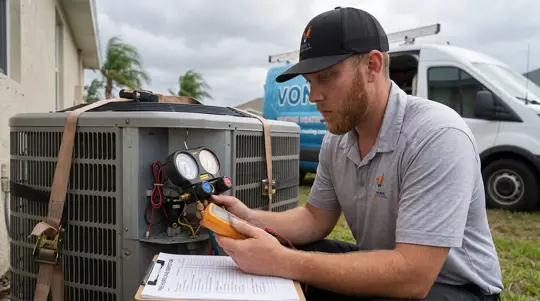
A pre-season AC maintenance visit from Von's includes:
- Coil cleaning to restore heat transfer
- Refrigerant level check and top-off if needed
- Capacitor and contactor inspection for early signs of weakness
- Electrical connection tightening at the condenser and air handler
- Condensate drain flush to prevent water backup during heavy rains
- Airflow testing through your ductwork
The tune-up doubles as a safety audit. Your technician will flag anything that looks likely to fail under storm conditions, so you can fix it before it becomes a crisis.
Protect Your Outdoor AC Unit From Wind and Flooding
A few practical moves before each storm make a real difference:
- Secure the outdoor unit with hurricane straps if you live in a flood-prone or high-wind zone.
- Clear debris from around the condenser so branches, patio furniture, and landscaping don't become projectiles.
- Elevate the unit on a pad or stand if your property has flooded in past storms.
- Turn off the power to the AC at the disconnect and breaker before the storm arrives to protect against grid surges.
After the storm passes, don't restart the system until a technician confirms there's no water in the electrical components. A wet unit powered back on too quickly is a fire and electrocution risk.
Get Your HVAC Storm-Ready With Von's Heating and Air
Hurricane season arrives in Orange Park on June 1, and the smartest preparation happens in April and May. Waiting until there's a storm on the radar means emergency pricing, long waits, and rushed work.
The team at Von's Heating and Air specializes in surge protector installation, HVAC wiring inspection, and pre-season efficiency tune-ups for homes across Orange Park and the Jacksonville area. We'll walk you through what your system actually needs, so you head into hurricane season confident.
Call Von's Heating and Air at (904) 621-2953 to book your hurricane-season HVAC inspection today. Or visit our contact page to schedule an appointment online.