
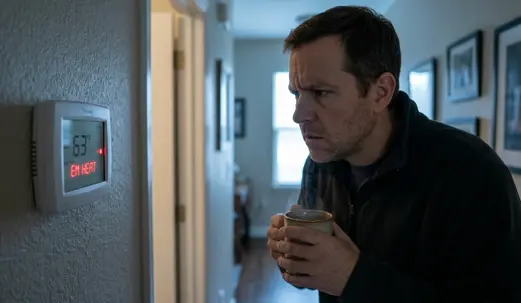
Your heat pump has likely been quiet since spring. Then a cold snap hits Northeast Florida, and the thermostat shows a glowing red light that says EM HEAT.
Should you flip that switch? Most homeowners guess, and the guess often costs them real money.
That Red Emergency Heat Light Makes Your Stomach Drop
You walk past the thermostat on a chilly morning. The house feels cold, and the screen says 'EM Heat'. Emergency Heat or Aux Heat.
Now you're wondering if something broke. You're also wondering what this will do to your power bill.
Those worries are fair. Emergency heat is the most expensive way to heat your home with a heat pump.
Many Florida homeowners switch it on during the first cold snap. They figure "emergency" means "extra warm." Then the electric bill arrives.
In this article, we'll explain what the EM Heat setting does and when it makes sense. We'll also show you where to find help if your heat pump needs a repair.
What Heat Pump Emergency Heat Really Means
A heat pump moves heat from outdoor air into your home. Emergency heat turns that process off.
According to PickHVAC's emergency heat guide, emergency heat is a manual mode. It locks out the outdoor unit and runs only the backup heater.
In most Florida homes, that backup is a set of electric resistance strips inside the air handler. Think of a giant toaster warming your air.
Electric strips make one unit of heat for each unit of electricity. A working heat pump makes two to three.
That gap is why emergency heat costs several times more per hour. PickHVAC's example uses $0.16 per kilowatt-hour, close to the recent U.S. average. At that rate, a 10 kW strip costs about $1.60 an hour. A heat pump delivering 20,000 BTU an hour runs about $0.37 to $0.40.
Emergency Heat Is Not the Same as Aux Heat
Your thermostat may show two similar labels. They do different jobs.
- Emergency heat (EM): You turn it on by hand. The heat pump stops, and only the strips run.
- Auxiliary heat (AUX): The thermostat turns it on by itself. The heat pump keeps running, and the strips add a boost.
If you see AUX, nothing is wrong. Your system is asking for extra help on a cold morning.
If you see EM, someone or something chose the manual setting. Check whether a family member bumped it.
Defrost Mode Can Look Like a Problem
Cool, damp nights build frost on the outdoor coil. Your heat pump clears it with a defrost cycle.
Lennox says a defrost cycle usually lasts 5 to 15 minutes. Most systems check for frost every 30 to 90 minutes in heat mode.
Lennox also notes that many heat pumps switch on backup strips during defrost. That's why you might see AUX light up for a few minutes.
A short AUX light during defrost is normal. Don't switch to emergency heat for it. Wait 15 minutes first.
Cold air at the vents is a different story. Our guide to a heat pump blowing cold air walks through those causes.
Why Florida Homes Rely on Heat Pumps
Electric heating is the norm across the Southeast. The U.S. Energy Information Administration reports that 42% of U.S. households used electricity as their main heating fuel in 2024.
Florida winters are short and mild. A heat pump handles nearly every cool night without backup help.
That makes emergency heat a rare tool. You'll use it only when the outdoor unit can't do its job.
When Emergency Heat Is the Right Call
Use emergency heat only when your heat pump has failed and you're waiting on a repair. PickHVAC lists four clear situations.
- The outdoor unit won't run or makes grinding or screeching noises.
- A solid block of ice covers the outdoor unit, fan, or coil.
- The breaker trips again and again.
- A thermostat or sensor fault blocks safe heat pump operation.
In those cases, emergency heat keeps your family warm until a technician arrives. Switch it on, then call right away.
When to Leave the Thermostat on Heat
Light frost, a slow warm-up, and a cold morning are not emergencies. Keep the thermostat on Heat or Auto.
Skip the old rule about switching to emergency heat below a certain outdoor temperature. PickHVAC calls that advice outdated.
Also avoid deep nighttime setbacks. A big jump in the morning can trigger the strips and raise your bill.
What to Do If Emergency Heat Keeps Running
Say your thermostat stays on EM or AUX for hours. Run through these steps.
- Set the thermostat to Heat and the fan to Auto.
- Replace the air filter if it looks gray.
- Check the outdoor unit for ice, leaves, and debris.
- Look at the breaker panel for a tripped switch.
Still no steady warm air? You likely have a failing part, such as a control board, sensor, or low refrigerant.
Refrigerant work belongs to a licensed technician. The EPA confirms you can keep repairing existing heat pump systems, including major parts like a compressor.
Get Heat Pump Repair in Jacksonville Before the Strips Run Up Your Bill
Every hour on emergency heat costs more than normal heating. A fast repair pays for itself.
Vons Heating and Air serves Orange Park, Jacksonville, and Clay County. Visit the heat pump repair page to see how a repair visit works.
Keep Your Heat Pump Working Through the Cool Months
Emergency heat is a backup mode, not a comfort setting. Leave it off unless your outdoor unit has failed.
Defrost and AUX heat are normal. A stuck EM light, ice, or cold air that won't quit means it's time for a trained technician.
Vons Heating and Air helps Northeast Florida homeowners stay warm without a surprise power bill.
Call Vons Heating and Air at 904-621-2953, or send a request through the Vons contact page.
Frequently Asked Questions
What does emergency heat mean on a heat pump?
Emergency heat is a manual setting that shuts off the outdoor unit. Only the electric backup strips run, which costs far more than normal heat pump operation.
Is it bad to use emergency heat on a heat pump?
Not for a short time during a real failure. Running it for days wastes money, so book a repair as soon as the outdoor unit stops working.
Should I use emergency heat when it gets cold in Florida?
No. Keep the thermostat on Heat or Auto. Your heat pump handles Florida cold snaps, and AUX heat turns on by itself when needed.